1. Annual General Meeting (AGM)
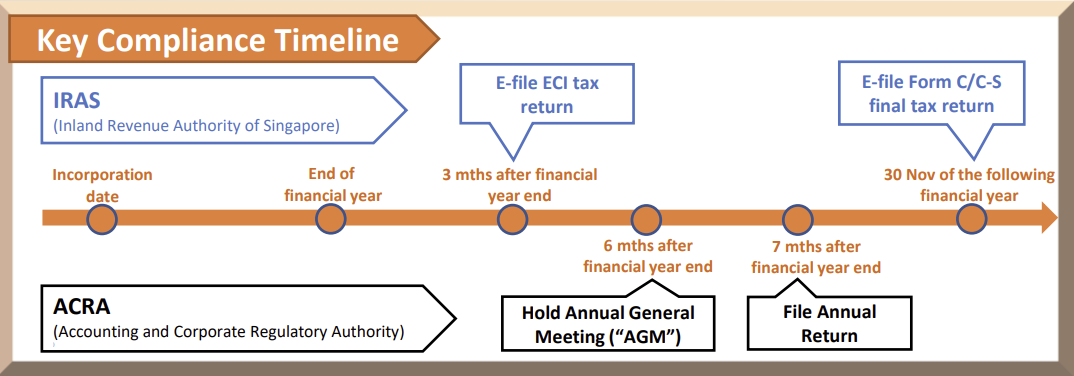
Hold an AGM: Private companies must hold an AGM within 6 months from the end of their financial year. At the AGM, the company’s financial statements are to be presented to shareholders for approval.
2. Filing Annual Returns
Submit Annual Returns to ACRA: Companies must file their annual returns with ACRA within one month of their AGM. The annual return includes information about the company’s officers, registered address, shareholders, and financial statements.
3. Financial Statements
Prepare Financial Statements: Companies are required to prepare financial statements that comply with the Singapore Financial Reporting Standards (SFRS). These should be ready for presentation at the AGM and for filing with the annual return.
4. Estimated Chargeable Income (ECI)
File ECI with IRAS: Within three months of the financial year-end, companies must file an ECI, which is an estimate of the company’s taxable income for the year.
5. Corporate Income Tax Returns
File Tax Returns: File Form C-S/C with IRAS. The filing deadline for Form C-S/C is November 30 for paper filing and December 15 for e-Filing.
6. Tax Computation
Prepare Tax Computations: Calculate the taxable income by adjusting the net profit/loss as per the financial statements against tax allowances and deductions.
7. GST Reporting
GST-Registered Companies: If your company is registered for Goods and Services Tax (GST), it must file GST returns. This is typically done on a quarterly basis.
8. Record Keeping
Maintain Proper Records: Companies are required to keep financial records and other transactional documentation for at least five years.
9. Updating Corporate Records
If there have been changes in the company, such as changes in shareholdings, directorships, or company structure, these must be updated with ACRA.
10. Compliance with Other Obligations
CPF Contributions: If the company employs Singaporeans or Singapore Permanent Residents, ensure timely and accurate Central Provident Fund (CPF) contributions.
Foreign Worker Levy: If employing foreign workers, comply with the foreign worker levy requirements.
Was this article helpful?
That’s Great!
Thank you for your feedback
Sorry! We couldn't be helpful
Thank you for your feedback
Feedback sent
We appreciate your effort and will try to fix the article